The History of ChatJPT: From One HTML File to 16 AI Providers
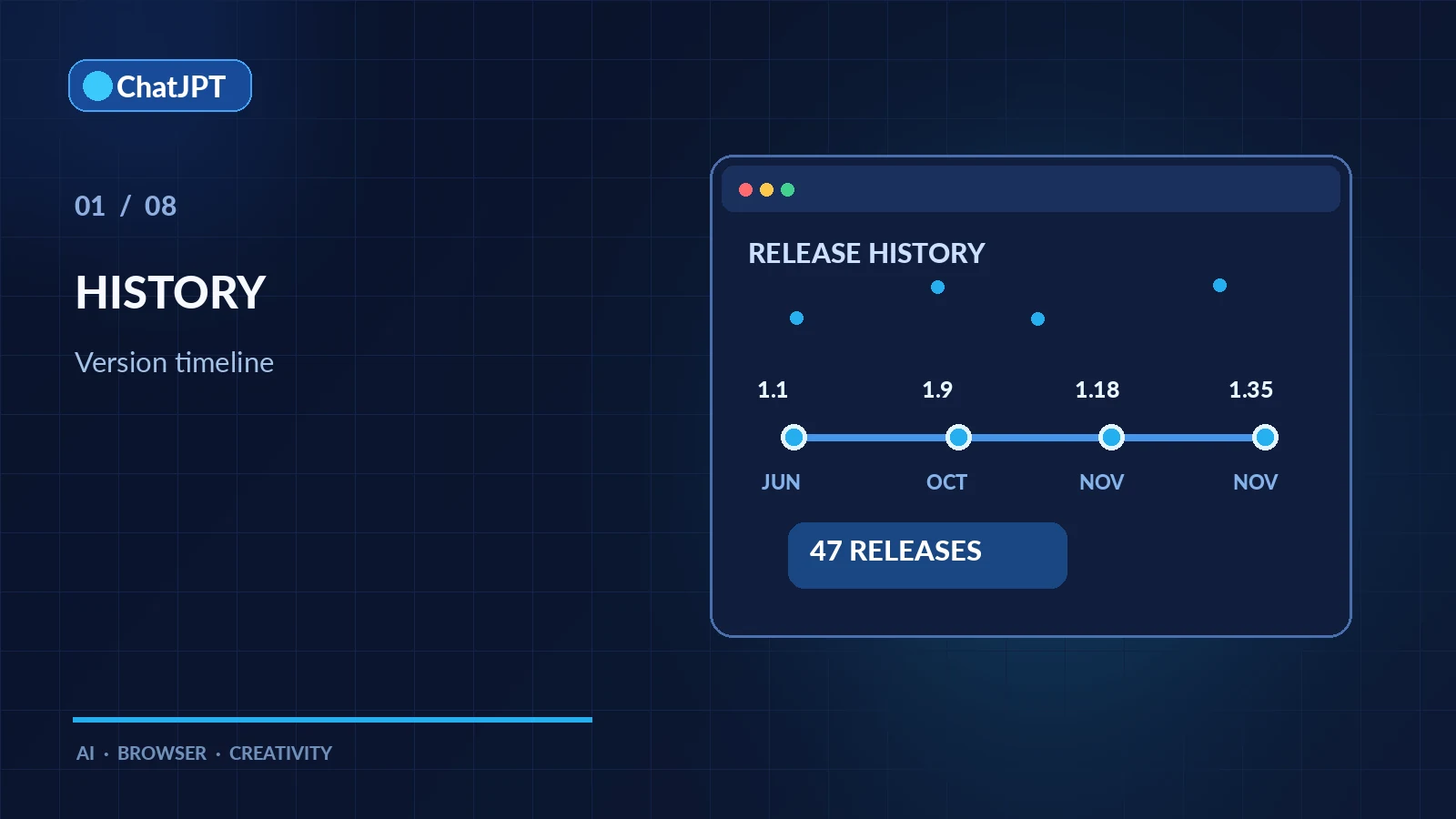
The history of ChatJPT spans five months and 47 versions. At first, the project was a simple chat interface in an HTML file. Today, ChatJPT brings together 16 AI providers, six working modes, and three languages, still in a single file you open in your browser. Here are the major milestones, version by version.
June 2026: Laying the Foundations
Version 1.1 was published on GitHub on June 1, 2026. It already offered chat with OpenAI, Claude, and Gemini, image generation, and an early video mode. The principle was there from day one: no installation, no server, and requests sent directly from the browser to each provider.
From there, things moved quickly:
- 1.2 (June 4): DeepSeek and Qwen (Alibaba) arrived, along with the key comparison mode, which sends the same question to two models side by side.
- 1.3 (June 5): Grok (xAI) joined with chat, image, and video capabilities, plus a button to erase all API keys at once.
- 1.4 (June 6): Multiple conversations, text search, editing a previously sent message, and regenerating a response.
- 1.5 and 1.6 (June 6–7): Images were saved in the browser, followed by a token counter and web search with sources.
- 1.7 (June 8): Reading pasted links became a separate option from web search.
Within a week, the foundation was in place. The single-file approach, described in the article on building an AI application in one HTML file, made this pace possible: each release could be tested simply by opening the file.
October 2026: Opening Up to the World
After a summer break, version 1.8 (October 6) updated all the models. Then the project expanded to new providers and formats:
- 1.9 (October 17): Perplexity, for web-grounded answers with sources.
- 1.10: Reading scanned PDFs, through transcription or as images.
- 1.11 to 1.13 (October 23): The image editor. First, edit an image using a sentence, remove its background, or change its aspect ratio; then erase, annotate, or point to a precise area with a brush; finally, these tools worked with Gemini, Qwen, and Grok, and an image could be animated into a short video.
- 1.14 (October 25): Mistral AI joined, and the API-key panel was now grouped by country.
- 1.15 to 1.17: Kimi (Moonshot AI), then Augure (Montreal), then Gemma 4, Google’s open-source model.
Grouping providers by country was not merely cosmetic. It followed the ChatJPT philosophy: you should be able to choose where your data is processed.
November 2026: Images, Voice, and Video
In early November, releases became a daily occurrence.
- 1.18 (November 2): Cohere, the second Canadian company.
- 1.19 to 1.23 (November 3): Meta (Muse), support for Word and Excel files, Upstage (South Korea), two image-only providers—Recraft (United Kingdom, SVG vector images) and Bria (Israel, images trained on licensed content)—and finally MiniMax with chat, image, and Hailuo video.
- 1.24 to 1.28: The birth of Voice mode, extending and editing videos, voice generation from five providers, two-host podcast creation, and then creating and cloning personal voices.
The Latest Versions: Research and Precision
The first week of November ended with advanced features:
- 1.29: GPT Image 2.6, including animated GIF and SVG, plus OpenAI’s Ultrafast mode.
- 1.30 and 1.31: A Gemini voice explorer, panoramic formats, and your own Gemini voices.
- 1.32: Gemini Deep Research, with an editable plan before starting.
- 1.33 to 1.35: Each major provider received a detailed review. Claude gained fast mode and page-by-page PDF reading with citations; Grok gained X search and multi-agent mode; Alibaba gained web search, Wan video, and its own deep research.
What the History of ChatJPT Shows
First, ChatJPT’s history shows that a lightweight tool can keep up with the rapid evolution of AI providers: new models appear every week, and a single file can adapt quickly. Second, every addition follows the same rule: if a provider blocks direct calls from the browser, it is excluded rather than routed through a server. Finally, the tool remains free, with no account required.
Want to try it? The guide to using ChatJPT walks you through the process, and the code for every version is published on GitHub.